
Cooking
Reading the colour
Pale, golden or crisp, and how to tell.
Every order says how the crêpe should be cooked: pale, golden or crisp. If the guest says nothing about it, golden is what they mean.
| Doneness | What to look for | |
|---|---|---|
 | Pale | Set and soft, the lace only just showing. Barely kissed by the heat. |
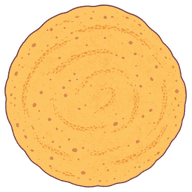 | Golden | An even golden brown with a freckled, lacy pattern. |
 | Crisp | Deeper brown, crisp at the edge. You can hear it. |
 | Burnt | Too far. Dark patches and smoke. |
The doneness bar
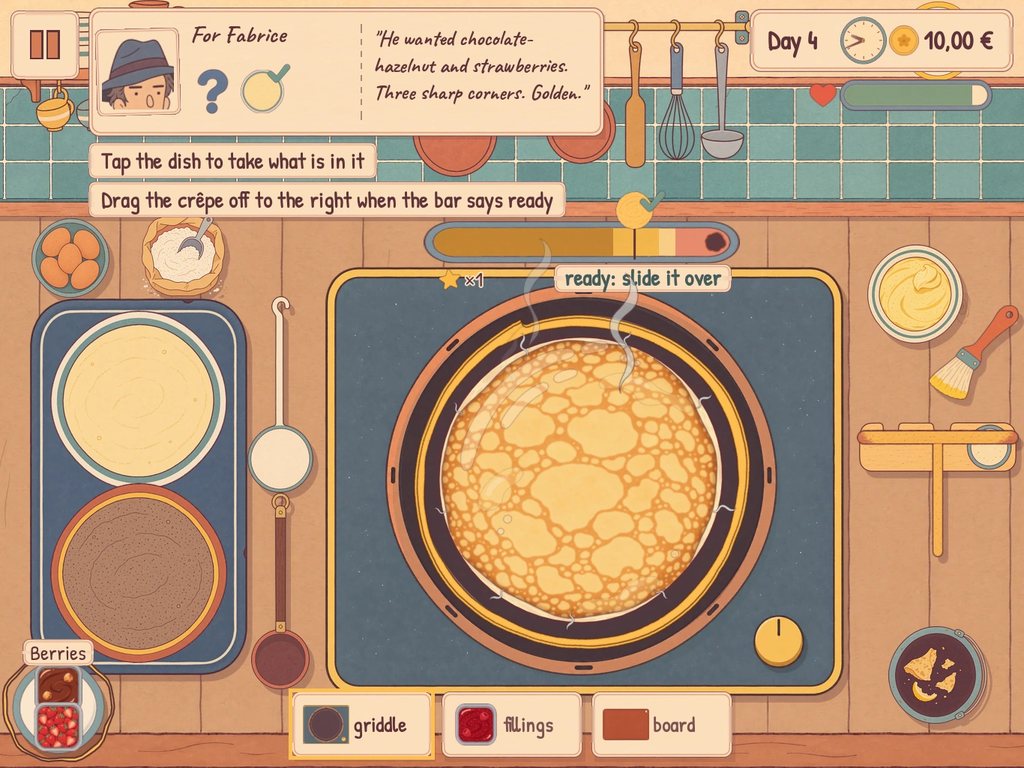
Above the griddle a bar fills as the side on the heat cooks: not yet, pale, golden, crisp, burnt. The zone the order asks for stands in a box. When the colour is in it, a call pops up: "ready: flick up!" on the first side, "ready: slide it over" on the second, and a chime rings at the perfect moment. Past it, the call turns to "flip now!" or "take it off!", then "overdone".
Reading the crêpe itself
The wet batter sets and turns lacy, colour creeps in from the rim, bubbles rise and steam curls up. Rest a finger on the edge for a moment and the spatula lifts the edge so you can see underneath. Tapping the butter crock while a side is on the heat butters the rim, which makes the perfect moment a little longer and the crêpe a little better.
While the first side cooks, keep an eye out for:
- Bubbles: tap them flat.
- Hot spots: a dark patch with a red ring. Left alone it burns a mark into the crêpe; tap it.
- Curled edges on the second side: tap them down before the crêpe comes off.
The heat
The knob on the griddle switches between normal and gentle heat (only while the iron is bare). Gentle cooks more slowly: more time to get the colour right, while the guest waits a little longer. Some days the bilig runs hot or gentle by itself; a tab at the foot of the iron says so.
Getting better at it
- Well-Seasoned Bilig gives even heat: every ready moment lasts longer. It never cooks faster.
- Crêpière's Instinct takes the helper away so you cook by eye and ear, and guests tip the show.